
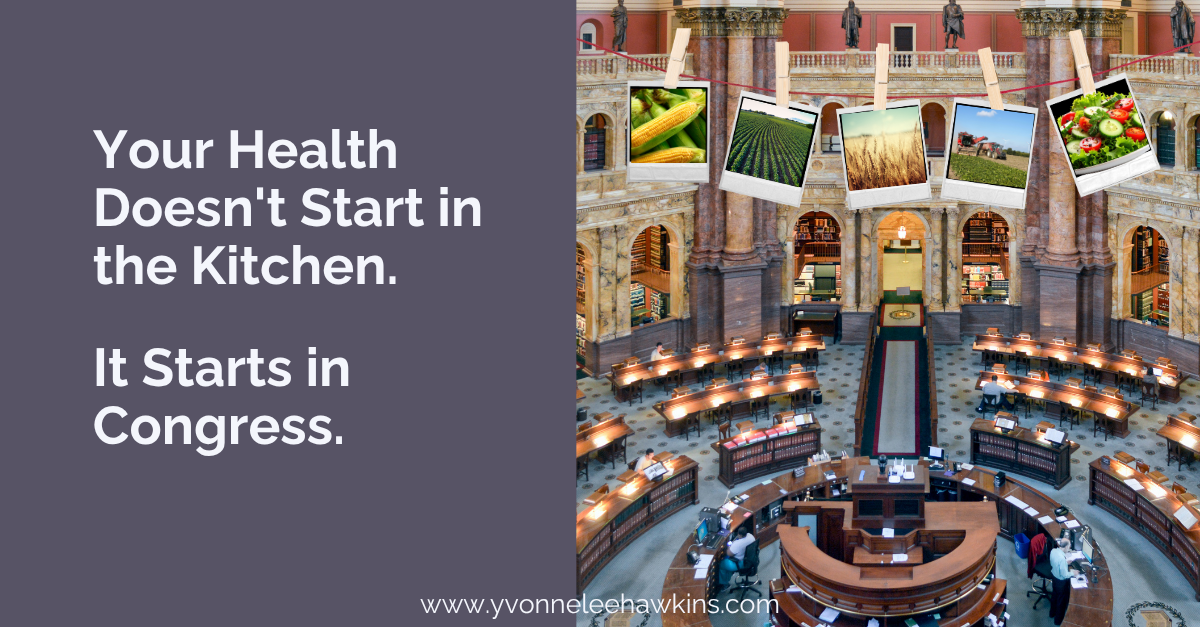
Most people think the road to better health begins in the grocery store.
It doesn’t.
It begins decades earlier—in legislative chambers, agricultural committees, and boardrooms where decisions are made about what gets grown, what gets subsidized (aka paid for by tax dollars), and ultimately, what becomes the cheapest thing to put on your dinner plate.
By the time you pick up that box of cereal or bottle of salad dressing, someone else has already made hundreds of decisions that influence what you’re eating.
That’s why wellness isn’t just personal.
It’s political, economic, and cultural.
Food: The Most Powerful Daily Health Decision We Make
If you ask researchers what contributes most to chronic disease, one answer consistently rises to the top: diet. One of my favorites to follow is Dr. Greger who runs nutritionfacts.org because he uses evidence based science to discuss everything from the foods you eat to how to prevent death and disease.
The foods we eat every day influence inflammation, blood sugar, hormones, gut bacteria, cardiovascular health, cognitive function, immune response, and even our mental well-being.
Unlike genetics, which we can’t change, or age, which we can’t stop…we make food choices multiple times every single day. Every meal is either providing the body with nutrients it can use to repair itself or asking it to compensate for nutrients it never received.
That’s not about perfection. It’s about patterns. The good news? Our bodies are incredibly resilient. The bad news? They’re also incredibly responsive. What we repeatedly feed them matters.
How Corn Syrup Took Over America
One of the most fascinating, and troubling, examples of policy shaping our health is the story of high-fructose corn syrup. If you haven’t noticed, just take a look at any food label and you’re likely to find some version of corn syrup in the list of ingredients.
And if you think, Corn is healthy, so what’s the problem? Just know that this form of corn is not a vegetable, but a sweetener. It’s a sugar substitute that is highly processed and evermore ubiquitous. So what gives?
Before the 1970s, Americans consumed relatively little of it because it barely existed in the food supply. Then several things happened at once.
New technology made it inexpensive to convert corn into sweeteners. At the same time, U.S. agricultural policy increasingly supported large-scale corn production through farm subsidies, making corn abundant and comparatively inexpensive. What that means is farmers who didn’t grow corn were now incentivized to grow it because it came with tax dollar money. Money that would help their farm stay in business.
Also at the same time, sugar prices were affected by import quotas and tariffs, making traditional cane sugar more costly for manufacturers. Meaning, rather than importing expensive sugar cane, which is mostly grown in tropical regions of Brazil, India, Thailand, China and Australia, we could make something sweet (corn) right here in the U.S.
The result?
Food companies discovered they could sweeten products with a cheaper ingredient that blended easily into processed foods and extended shelf life.
Within a few decades, high-fructose corn syrup found its way into soft drinks, breads, ketchup, yogurt, barbecue sauce, salad dressings, cereals, snack foods, and countless other products. I challenge you to find a label that doesn’t include it. It’s even in your marinara.
It wasn’t because consumers demanded it. It was because economics rewarded it. Always follow the money. Incentives drive behavior.
Today, many processed foods contain multiple forms of added sugars, making it surprisingly easy for people to consume far more than they realize.
Years ago when we lived in Upstate New York, I recall going to a museum in Saratoga Springs and being shocked by the clothing inside the museum. The dresses, from the 1800’s fashion, were what I’d describe as a size zero. One of the placards said that people in those days were much smaller in the waist line; one theory being that most people only consumed about 10g of sugar a week, with sweeteners not readily available. Fruit was only available in the summer time when it was ripe. Compare that to the average consumption of 126g per person per day in the U.S., according to the Center for Disease Control (CDC).
Our Economic Policies End Up on Our Plates
This isn’t just about corn, or the insame amount of sugar in the Standard American Diet (whose acronym is fittingly SAD). It’s to note that government policies influence which crops are profitable to grow, which foods are affordable to manufacture, and which products dominate grocery shelves. Farmers grow what they can sell (or get paid for), manufacturers use what is cheap and available, and groceries stock shelves with what people will buy (based on what is available and affordable).
When commodity crops receive significant support while fresh produce often receives comparatively less policy support, processed foods made from those commodity ingredients can become remarkably inexpensive. Certain calories become cheap. Nutrition often does not.
That doesn’t mean farmers are the problem. They’re responding to the incentives that exist. It doesn’t mean every processed food is harmful either. Many are convenient, safe, and can fit into a balanced diet. But it does mean our food system is shaped by forces much larger than individual willpower.
When healthier options cost more, require more preparation, or are less accessible, personal responsibility becomes only part of the story.
Reading Labels Isn’t Enough
For years we’ve been told to read nutrition labels. That’s excellent advice. You should know what you’re putting into your body. But perhaps we should also start reading legislation.
Because laws determine:
- Which crops receive subsidies.
- How foods are labeled.
- What ingredients manufacturers can use.
- What children are served in schools.
- What food companies can market.
- How nutrition programs are funded.
Those decisions eventually show up in our kitchens. Every public policy creates private consequences. Sometimes those consequences are obvious. Sometimes they take decades to appear.
Wellness Is Civic Engagement
Taking care of yourself isn’t just about exercising more or cutting back on sugar. It’s also about understanding the systems that shape your choices. If we want healthier families, healthier children, and healthier communities, we need conversations that extend beyond calorie counting.
We should ask questions like:
- Why are ultra-processed foods often less expensive than fresh produce?
- What incentives are driving our agricultural system?
- How do we balance supporting farmers while also encouraging greater access to nutrient-dense foods?
- What role should government, industry, healthcare providers, and consumers each play in improving public health?
These aren’t partisan questions. They’re public health questions.
Three Things You Can Do Today
It’s easy to feel like our food system is too big for one person to influence. But every major change starts with informed citizens who decide to pay attention. Here are three ways you can begin today.
- Vote with both your ballot and your grocery cart.
Every purchase sends a signal. Whenever possible, support local farmers, farmers markets, community-supported agriculture (CSA) programs, and companies that prioritize transparency in their ingredients and sourcing. At election time, ask candidates where they stand on issues that affect the food system—not just healthcare costs, but the policies that influence health long before people become patients.
- Start conversations that create awareness.
Most people don’t realize how closely agriculture, economics, and public health are connected. Share what you learn with your family, your children, your coworkers, or your community. Ask questions instead of making assumptions. Encourage respectful conversations about how we can create a food system that supports both thriving farmers and healthier communities. Awareness is contagious, and meaningful change often begins around the dinner table.
- Learn where your food policies come from.
Take 15 minutes this week to find out who represents you at the local, state, and federal levels, and what committees they serve on related to agriculture, nutrition, or health. Pay attention to proposed legislation involving food labeling, school nutrition, farm subsidies, or access to fresh foods. You don’t have to become a policy expert—just an informed voter. The more we understand how food policy is made, the more intentional our voices become.
A tool that helps you find who your local, state, and federal representatives are is called Ballotpedia and you can look it up using your zipcode. https://ballotpedia.org/Who_represents_me
We may not be able to change the entire food system overnight, but we can become more informed consumers, more engaged citizens, and stronger advocates for policies that make nutritious food more accessible for everyone. The future of our health isn’t determined by one meal—it is shaped by millions of daily choices, both at the checkout line and at the ballot box.
The Bottom Line
Your fork is one of the most powerful tools you have for protecting your health. But don’t forget that someone helped decide what was available to put on that fork.
This Wellness Wednesday, challenge yourself to become more aware. First, read the ingredient label of the food you are buying. Second, something much more difficult, but equally important, is to pay attention to the policies being debated by the people you elect. Food policy, agricultural policy, nutrition policy, and healthcare policy are all connected in ways that eventually affect every family. I often hear people say, “I’m no into politics.” I would say, “why not?” It’s not just about school boards and taxes, left versus right, democrat versus republican. It’s about whether we allow a system of incentives to unintentionally poison us, the slow and painful way.
Because health isn’t created in doctors’ offices, gyms, or by health insurance companies.
And it isn’t created only in kitchens. It begins with awareness.
The more we understand the connection between what happens in our government, our food system, and our own bodies, the better equipped we are to make choices—not only for ourselves, but for future generations.
After all, the laws we pass today may become the ingredients our children read on their labels tomorrow.