TV, Billionaires, and Bananas
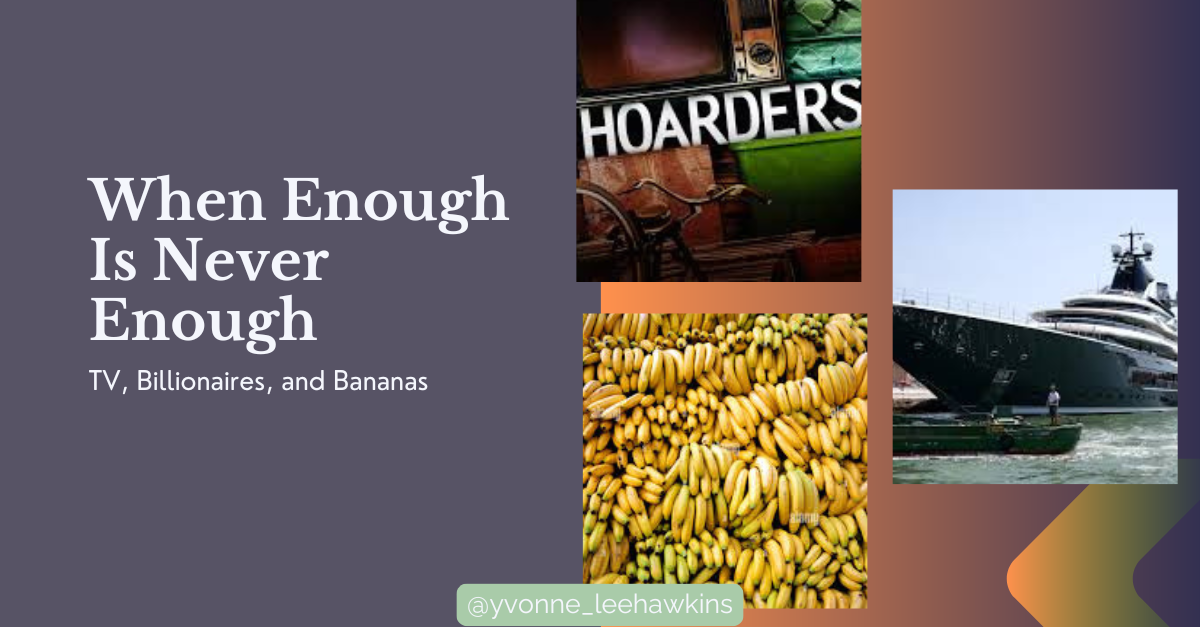
I remember the first time I watched an episode of Hoarders.
It was a Tuesday night, sometime in the late 2000s, and I sat in my living room completely transfixed; half horrified, half unable to look away, as a camera crew helped excavate a woman’s home that contained, among other things, seventeen years of unopened mail, forty-three cats, and what the producers diplomatically described as “organic matter of unknown origin.” By the time the closing credits rolled, I had already mentally catalogued every closet in my house, drafted a donation pile in my head, and developed a sudden, urgent hostility toward the ceramic statue on my kitchen counter that I’d been meaning to get rid of for two years.
I cleaned for days straight.
My husband, bless him, watched me drag bags to the door with the focused intensity of a woman who had seen something and could not unsee it. By day two, when I started eyeing his side of the closet, he sat me down with the quiet gravity of a man staging an intervention.
“We,” he said carefully, “are not hoarders.” As he pried a kitchen gadget we used just last week, out of my hands so I didn’t put it in the donation pile.
He was right. We were not hoarders. And I agreed that perhaps I should not watch the show, which remains, to this day, one of the most powerfully motivating pieces of television ever produced. No therapist, no Marie Kondo book, no New Year’s resolution has ever moved me to action with the speed and efficiency of forty-five minutes of Hoarders.
It is the nuclear option of home organization. But here’s where it gets interesting — and a little inconvenient for what most of us have been taught.
Hoarding Disorder is a real, clinically recognized mental illness. The Diagnostic and Statistical Manual of Mental Disorders (DSM-5) formally classified it as a distinct condition in 2013, defined by the persistent difficulty discarding possessions, regardless of their actual value, accompanied by a compulsion to acquire more. The American Psychiatric Association notes that hoarders experience genuine distress at the thought of letting things go — not because the objects are useful, but because the accumulation itself feels necessary. Researchers estimate it affects between 2 and 6 percent of the population (Frost & Steketee, 2010), and it correlates with significant impairment in daily functioning, relationships, and quality of life.
In other words, science has looked at the behavior of accumulating far more than you need, being unable to stop acquiring, and finding the idea of letting go genuinely distressing — and called it what it is: a disorder.
Now. Let us gently turn our gaze toward a different kind of accumulation.
As of 2024, the world’s billionaires collectively hold more wealth than the bottom 60 percent of the global population combined (Oxfam, 2024). Elon Musk’s net worth has at various points exceeded the GDP of countries. Jeff Bezos could fully fund global childhood hunger relief programs for years and still retire richer than anyone reading this sentence will ever be. And yet, the acquiring continues. The competition continues. The inability to say enough continues.
At what point does the relentless accumulation of wealth far beyond any functional use stop being called “success” and start being evaluated through the same clinical lens we apply to the woman with forty-three cats?
I am not, to be clear, suggesting that billionaires are mentally ill. That would be both reductive and probably libelous. What I am suggesting is that we have constructed a society with a remarkably inconsistent relationship to nature. In nature, if you’re a monkey who hoards all the bananas, not only will the other monkeys come take them from you, but the bananas will continue to ripen and decompose. So, it forces the monkey to value enough and cooperative community, instead of accumulation. We made a television show — a very successful one — dedicated to the spectacle of regular people accumulating more than they need, and we watch it as a cautionary tale, a window into dysfunction, a call to action. We feel moved to clean our own homes afterward. We recognize excess when it lives in a two-bedroom ranch in Ohio.
We are significantly less likely to pathologize it when it lives in a billion dollar mansion with a helipad, because this, we have labeled as “SUCCESS.”
The DSM defines the problem, in part, as acquiring “regardless of actual value” and causing harm to the surrounding environment. So, let’s talk about harm. While billionaires are quietly ordering yachts so large they require their own support vessels just to dock — and yes, that is a real thing that actually happens — millions of Americans are simultaneously losing access to healthcare, watching food assistance programs get gutted, and doing the kind of math at the grocery store that no one should have to do. We are living in a moment where one person can spend more on a floating vacation palace than an entire county’s annual Medicaid budget, and the people who could write that check without flinching are instead writing checks to lobbyists. Houston, we have a problem. And unlike the Apollo 13 mission, no one appears to be working urgently on a solution.
The difference between a hoarder and a billionaire, as far as I can tell, is the quality of the storage unit.
My husband, for the record, remains vindicated. We are not hoarders. Our closets are functional, our ceramic statue is long gone, and I have made my peace with reasonable possession. I still spring clean and donate clothes and toys on a regular basis, because, well, kids. I will say this, though: if someone ever wants to produce “Billionaires” — with the same format, the same gentle intervention team, the same slow pan across rooms filled with excess luxury while experts explain the psychological roots of the behavior — I will watch every episode. And I won’t even feel the urge to clean.
— References
American Psychiatric Association. (2013). Diagnostic and statistical manual of mental disorders (5th ed.). American Psychiatric Publishing.
Frost, R. O., & Steketee, G. (2010). Stuff: Compulsive hoarding and the meaning of things. Houghton Mifflin Harcourt.
Oxfam International. (2024). Inequality Inc.: How corporate power divides our world and the need for a new era of public action. Oxfam Briefing Paper.