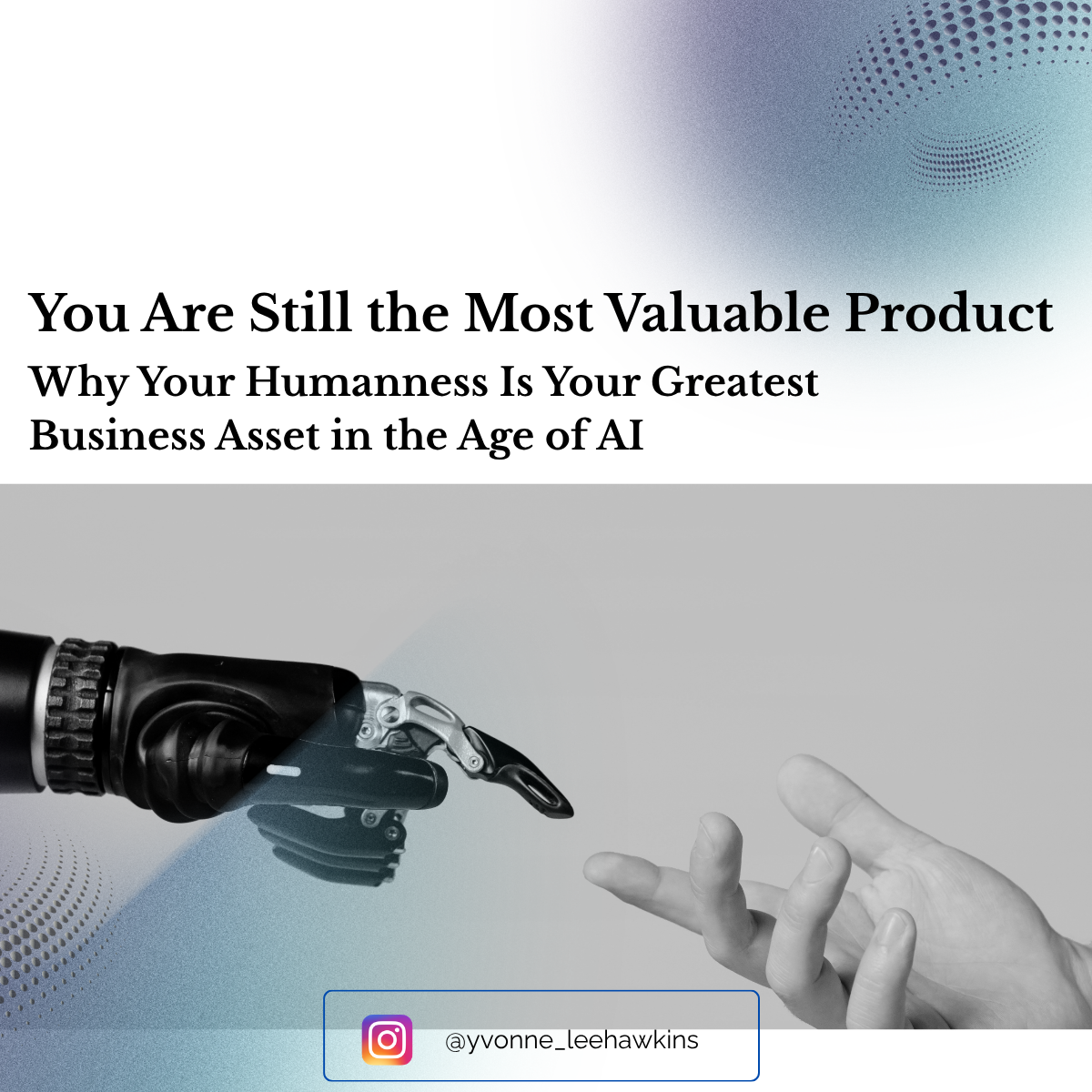
Why Your Humanness Is Your Greatest Business Asset in the Age of AI
Picture a busy professional, let’s call her Dana, sitting at her desk at 4:47 on a Tuesday afternoon. She needs an answer to a time-sensitive HR question about FMLA leave. Her company recently rolled out a shiny new AI assistant. “Perfect,” she thinks. This is exactly what it’s for.
She types in her question. The bot responds… with a link to a policy document. She reads the document. It sends her back to the bot. The bot sends her back to the document. Back and forth, around and around, like a revolving door with no exit. Forty-five minutes later, she’s no closer to an answer. She’s just frustrated, confused, and wondering if anyone at this company actually knows what’s going on.
No one saved time that afternoon. No one solved a problem. The AI didn’t fail because the technology was bad; it failed because it was deployed in the wrong place.
The Oldest Truth in Business
There is something no quarterly earnings report will ever show: business has always been, at its core, a human project. Humans make things. Humans buy things. Humans trust other humans, choose other humans, and feel something when another human gets it right. That fundamental architecture has not changed. Not with the industrial revolution, not with the internet, and not with large language models.
What has changed is the noise level. Right now, organizations are in a full sprint to automate everything they can. And many of them, in their eagerness to appear modern, to cut costs, to “lean in” to AI, are quietly eliminating the very thing that made them worth choosing in the first place.
The companies that will win long-term are not the ones that replace humans with AI. They’re the ones that understand exactly where AI can help the humans be more efficient and effective and where it can’t.
IKEA Didn’t Lay Off a Single Person — and Grew by Millions
You’ve probably heard this story. It’s become a popular use case. When IKEA made the decision to integrate AI into its customer service operations, it did something remarkable: it chose not to let a single employee go. Instead, it retrained its 8,500 call center workers and instead trained them as interior design advisors. Rather than answering repetitive product questions, these employees were repositioned to help customers envision and design their living spaces (a customer need that IKEA had previously not met). These CS reps who already knew the company culture and were cheerleaders for it every day were given the chance at a new and deeply human, creative, consultative role that no chatbot can replicate with any real feeling.
The result? IKEA didn’t just maintain its workforce. It grew its revenue by hundreds of millions. The AI handled the transactional. The humans handled the transformational. That’s not a feel-good HR story. That’s a blueprint.
Most companies are reading that story and nodding along while doing the exact opposite. And often the HR teams are the first ones impacted.
Your Humanness Is Not a Liability. It’s the Asset.
We are entering an era where being an authentic human is a competitive advantage. The things that make us messy — our judgment, our empathy, our capacity to read a room, to feel when something is off, to hold a grieving client’s pause in silence without rushing to fill it — are the exact things that cannot be automated. Not really. Not in the ways that matter.
LLMs are extraordinarily powerful at pattern recognition, synthesis, and speed. They are genuinely useful for drafting, researching, summarizing, and systematizing. But they do not have stakes. They don’t wake up at 3am worried about the decision they made. They don’t notice the thing the client didn’t say. How the client agreed, but didn’t leave truly satisfied. They don’t build trust through years of showing up. You do.
As AI becomes more woven into daily professional life, the professionals who understand this distinction will become exponentially more valuable. The ones who outsource their judgment wholesale to a tool will become replacable.
5 Practical Tips for Knowing When to Use AI vs. Your Own Intuition
- Use AI for the repeatable; use yourself for the irreplaceable. If the task follows a pattern, has a template, or has been done a hundred times before, AI is a strong tool. If the situation requires reading context, navigating nuance, or making a judgment call that carries real consequences, that’s yours to hold.
- Use AI to draft, yourself to decide. Let AI generate the first version of an email, a proposal, or a summary. Then read it as a thinking tool, not a final answer. The moment you hit send on something you didn’t actually read is the moment you’ve outsourced your judgment.
- When someone is scared, hurt, or confused — show up in person. Dana’s HR question wasn’t just a data retrieval problem. She was probably stressed. She needed a person. Any time emotion is part of the equation, AI is the wrong first call.
- Trust your gut when the stakes are high. AI can give you data and probability. It cannot feel the weight of a specific situation the way you can. If you have a strong internal signal and the AI is pointing elsewhere, that tension is worth examining. Jeff Bezos famously said “when data and anecdotes disagree, trust the anecdote.” Data misses nuance. The context matters.
- Ask: would I be comfortable if the person on the other end knew I used AI here? If yes, use it freely. If no, that discomfort is data. It means the relationship requires your real presence. Honor that.
The Future Belongs to the Humans Who Know Themselves
Here’s the irony of this moment: as artificial intelligence becomes more sophisticated, the demand for genuine human intelligence, the kind that is emotional, relational, and creative, is rising. The professionals who will thrive are not the ones who resist AI, and not the ones who surrender to it. They’re the ones who are clear enough about who they are and what they offer that they know exactly where to deploy each. Hint: recruiting top talent will NEVER come through an AI interview. It will only show you who is desperate enough to comply.
For many mid-career professionals right now, the noise is deafening. You’ve spent years building a skill set and a reputation, and now the ground is shifting beneath you. You aren’t sure if you’ll be layed off next, or maybe you already were. You’re not sure what’s still worth investing in, what to let go of, or what you even want the next chapter to look like. You’re not lost, but you might be stuck.
If that’s where you are, I want you to know: that feeling is not a signal that something is wrong with you. It’s a signal that you’re ready for something more intentional.
That’s exactly the work I do. I help mid-career professionals get unstuck. I have a framework, but I rarely use it, because each client has specific needs. Instead of pushing them through a process, I sit with them in the real complexity of where they are and help them find the thread that leads forward. Human to human. The way it was always meant to work.
If you’re navigating a career frustration and you’re ready to stop going in circles — like Dana and the HR bot — I’m here. Let’s find your way out of the loop.
***
Did this topic add value to you? Please like and subscribe if you want more topics like this, or DM me. I always love suggestions and feedback!
If you think you might be ready for a career change, take my Career Assessment HERE.
Yvonne Lee-Hawkins is a Holistic Career & Burnout Coach supporting high-performing professionals through career transitions, leadership challenges, and burnout recovery.
She also helps recent graduates land their first career. You can find out more on her website, or follow her on LinkedIn, Medium, or Instagram.
If you know someone who could use help beginning or transforming their career, have them schedule a call here.