
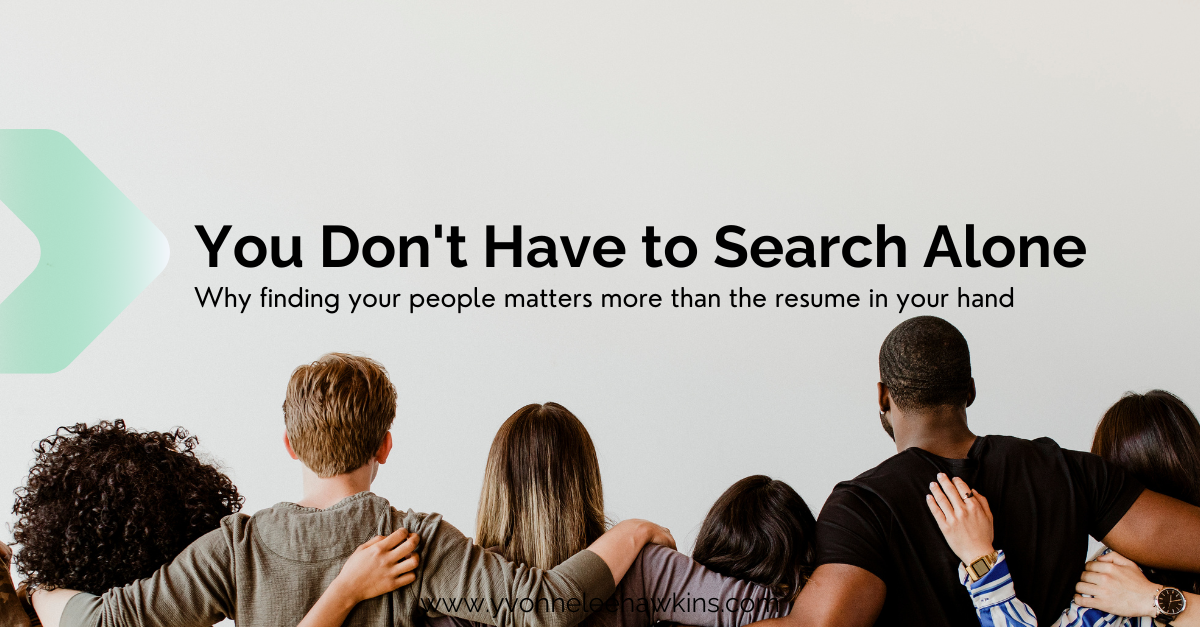
Why finding your people matters more than the resume in your hand
There’s an unnerving quiet that shows up after you leave a job, whether you walked out on your own terms or the decision was made for you. All of a sudden there are no more Slack pings. No more standing meetings that could have been an email. No more small talk by the coffee machine. It’s the kind of quiet that sounds like relief at first, and then starts to sound like something not so great: isolation.
Job searching doesn’t fill that silence, it usually deepens it. You submit fifty applications and hear back from two. You get to a final round and then a form email. Every rejection, even a polite one, chips away at the story you tell yourself about your own value. It’s even worse when you’re completely ghosted after a final round. Seriously, who does that?! It’s hard to feel confident walking into an interview when the last ten weeks have quietly taught you that you’re replaceable, forgettable, or simply not enough people’s first choice. Nobody warns you that the hardest part of a career transition isn’t the logistics. It’s the loneliness.
The instinct when loneliness shows up is to disappear a little. What actually works is the opposite: to ask.
Here’s what most people get wrong about asking for help — they assume it makes them a burden. They picture the eye-roll, the awkward pause, the friend quietly dreading another “will you look at my resume” message. But that’s not how most people experience being asked. Genuine requests for support don’t drain people — they light something up in them. Helping someone else navigate a hard moment makes the helper feel useful, capable, and connected. It’s not charity. It’s chemistry. When you ask well, you’re not begging — you’re giving someone else the chance to feel good about who they are, too.
Five Ways to Ask for Support Today (Without It Feeling Like Mooching)
- Lead with what you can give, not just what you need. Reach out to a former colleague and offer your bandwidth: “I’ve got some open hours right now — happy to help with anything you’re buried in.” An offer opens a door that a request alone often can’t.
- Ask the question that puts them in the driver’s seat. Instead of “do you know of any openings,” try: “Who do you know who could use some project management help right now?” Swap in whatever’s true for you — HR support, data processing, copywriting. Specific questions are easy to answer. Vague ones get ignored.
- Trade your skills for a conversation. Offer to review a deck, sanity-check a spreadsheet, or draft a job description in exchange for twenty minutes of someone’s time. It reframes the ask as an exchange between equals, not a favor owed.
- Name the specific ask, not the general situation. “I’m job searching” invites sympathy but not action. “Could you introduce me to anyone on your ops team at [company]?” invites a yes. The more specific the request, the easier it is for someone to say yes to it.
- Build a small, standing circle. Ask two or three people — searching or not — to check in with you every other week. A recurring conversation does more for morale than a hundred solo hours on a job board, and it gives the people around you a low-effort, ongoing way to stay involved.
Some things to do to feel confident (even when you don’t)
There is something really cool about our brain. When it comes to emotions, it can’t tell the difference between reality and a memory. So, if you aren’t feeling super confident because the last weeks, months, and maybe even years have worn you down. Try this. Get a piece of paper and pen and be ready to take some notes. First, stand up, take a deep breath. Close your eyes and recall a time you had a really fun or amazing job. Recall a particular moment where you felt you were winning. Remember what it was like to collaborate with team mates and have actual fun doing the work. How did you feel? What was it like? How did you stand? Where did you feel it in your body? Now write it all down. Did you stand tall? Did you feel energized? Did you have a giant beaming grin on your face? Take note.
Now, get into that posture right now even though you’re not feeling it. Take a deep breath, pull your shoulders back. Find that smile. Lean into that feeling. Now from that new state, make the next outreach, or call. The energy from that new state will help you a lot more than shrinking and quietly dying inside as you hit submit on one more application.
And One Thing You Can Do for Someone Else
If you’re not searching but someone in your life is, don’t wait for them to ask. Make an introduction they didn’t request. Send a job posting with one sentence explaining why you thought of them. Text them and ask the same question they should be asking others: “Who do you know who could use some help right now?” — then go find that person yourself. A single unprompted connection can do more for someone’s search, and their sense of self, than any amount of well-meaning encouragement.
Careers don’t move forward in isolation, and resilience doesn’t mean going alone. Careers are made in connections and conversations, one honest ask, one generous offer, one introduction at a time. You don’t have to search alone. You were never supposed to.
And if you need some help to get into that energized state, or to brainstorm who to reach out to, know that I’m just one DM away. This is the work I do with clients every day.
***
When working with clients I often
compare job searching to dating. Both can be super draining, both can leave you
feeling less than confident.
You show up energized hoping this is the one. You leave feeling deflated, like
there isn’t a single good one left out there.
Much like dating, finding the right job often comes not from swiping one more
time, or searching the corners of the web. Often, the right one is just waiting
for you to be introduced through a common friend or colleague.
Don’t feel bad if you’re searching alone. Try the above instead.
If you are currently job searching, I see you! You got this and have a lot to
offer the next person who is lucky enough to hire you. Keep going!
***
Did this topic add value to you? Please like and subscribe if you want more topics like this, or DM me. I always love suggestions and feedback!
If you think you might be ready for a career change, take the Career Assessment HERE.
Yvonne Lee-Hawkins is a Holistic Career & Burnout Coach supporting high-performing professionals through career transitions, leadership challenges, and burnout recovery.
You can find out more on her website, or follow her on LinkedIn, Medium, or Instagram.
If you know someone who could use help transforming their career, have them schedule a call here.